
Written by: Willie Poh Kaw Lik (0 words generated or researched by AI)
TLDR: Stop deleting your websites, kiddos.
This year’s IT Society President (Tharshen) is starting something new, and I’m writing this article in support of that, and so that I can just send the next tech committee lead a link instead of explaining this again, annually.
This is going to be a long one, but let me start with two short stories:
Stop Deleting Yourself, or I Resign
I’ve offered to resign as Advisor to IT Society two years in a row now, verbally, to the student President of the organisation and their leadership in general. It was an offer to get out of their way if they wish to keep doing things the exact same way to no avail. Good news for me my continued appointment in this role – they’ve decided to keep me and try something new while they’re at it.
What I wanted them to try, is to stop erasing information. “An Information Technology Society shouldn’t be so focused on the technology, we forget about the information. I’m sorry but I do not want to continue to be associated with this if you guys keep wiping out previous generations. I can’t,” I told them.
Before I give the wrong impression, I have a great working relationship with the last two generations of leadership. I’ve actually had a great relationship with most of the past 10 generations or so. These student leaders are some of the most brilliant, technically capable and responsible people I know, and I am proud to count them among my friends.
Yet despite that, I went so far because I’ve tried for YEARS to get them to do this one simple thing. So much so I have become convinced that long term thinking is simply unteachable. More on that later.
I Ran a Tournament for Asia in My First Year
I like to tell my students how I used to be pretty (very) active in student activities myself – it’s how I have a unique perspective on how student-run organisations and events work. The biggest event I organised was probably the 7th All-Asians Intervarsity Debating Championship. There are some exciting stories there – chief among which is signing away my life on a letter of intent with five zeroes behind it to book hotel rooms and ballrooms for a week.
How do they know I’m telling the truth, and not just bragging to impress the next gen? Even the Wikipedia page for the tournament series has been erased for not having enough original sources. They DON’T know I’m telling the truth.
Well – here’s my name on the top of the committee list for said event:
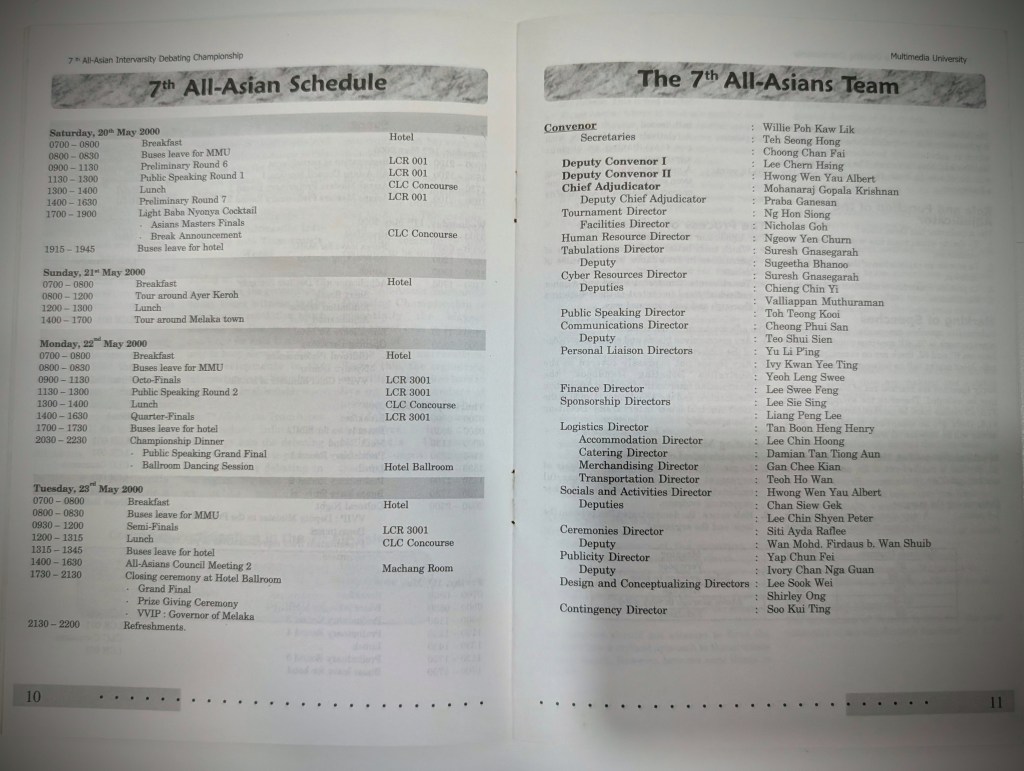
It’s a physical programme book for the event no one can erase off the Internet – with a foreword I wrote – with my signature below it. Sorry – had to drink in the pride for a moment. We made this, me and my team. (For this article’s likely audience, the sixth name down the list is probably a little bit more in your field.)
Yeah – so that’s lame. It’s a silly tiny book no one will ever see sitting on a shelf. It’s the age of everything’s-on-the-Internet! Say – who was President of IT Society in the year 2022? I checked – it’s not on Instagram, Gemini couldn’t tell me, and Google search turned up nothing. A very capable leader who helped keep IT Society alive over the pandemic MCOs and brought it back to the campus after – he doesn’t exist anymore, and it’s only 2025.
A Brief History of the IT Society Website(s)
We’ve gone a little ahead of ourselves, so let me break down a brief history of IT Society’s website(s) as I understand it. (I was the ‘unofficial advisor’ since 2015 on the request of its official advisor back then.)
Disclaimer before we begin – IT Society MMU Cyberjaya has actually existed since 1998. Due to organisational memory loss, we have not much in the way of records or history of its activities, websites or socials before 2015.
- In 2015, the leadership of IT Society, not having a website to work with from the previous generation, decided to set up a self-hosted WordPress site. They also wanted it to be an actively updated site – blogs, events, etc, that non-coders could post to and update. (We had a VP from FOM!)
- Tech Career Days – this event had a resume uploader system in Ruby on Rails. (Revived and supported for another 2 events)
- In 2017, the new tech team (possibly due to expiring hosting payments) rebuilt the website in Jekyll. Thankfully they converted the entire previous site. Thanks to the Markdown format of Jekyll, the site text since 2015 is preserved in GitHub. All image-based content is lost, however. Posts via Jekyll continued until December 2020 until they stopped. During this time, posts were limited to events and promotions only – essentially a glorified socials site.
- In 2021, over the pandemic, IT Society relied on socials only.
- BarCamp Cyberjaya – event needed a new system for online voting event forced to be virtual by pandemic
- CodeNection – new event – new website with custom functions.
- In 2022, after the pandemic, we had possibly the strongest web-development tech team the society had ever seen. They decided to build the main site from the ground up with a headless CMS with a promise to restore the articles from the Jekyll site. They launched in the middle of the year with only the front page. They were justifiably busy with:
- Tech Career Days – resume uploader site was rebuilt from the ground up in PHP.
- BarCamp – repurposed the old codebase for a new year without online voting
- CodeNection – rebuilt the codebase as easier than maintaining old one.
- In 2023, the inevitably new tech team attempted to continue 2022’s website, adding a few dynamic static pages. The blog feature was never completed.
- Tech Career Days – repurposed old codebase for a new year.
- BarCamp – set up the event site on WordPress (own site).
- CodeNection – repurposed old codebase for a new year.
- In 2024, the … again new tech team decided to rebuild the entire tech stack of the site (without a CMS), but the leadership pushed back and wanted to start a long-term main site on WordPress, which they did. (Yes I offered to resign too.) They restored the old Jekyll history, which restored articles since 2015.
- Tech Career Days – event was not held due to timing issues.
- BarCamp – set up the event site on WordPress (IT Society site).
- CodeNection – rebuilt the codebase from scratch.
- It’s 2025. Here’s the state of the sites:
- Main Website – 1+ year old WordPress site. New domain!
- Tech Career Days – 0 years old – new codebase for special functions.
- BarCamp – 1+ year old WordPress site.
- CodeNection – 0 years old – not sure yet but high chance of rebuild (change from competitive programming to hackathon).
I think just from this history alone, you can see the pattern and the point I am trying to make. Before 2015, IT Society has no public history, and we almost lost what we had since then between 2021 and 2024. And EVERY year, we erase the history of the previous event – who participated, who won, who came, who sponsored – all of it.
Two observations. One – IT Society does not lack for systems to build. Custom systems that serve very specific functions obviously have to be built out. In fact, many of the codebases that you can see above being repurposed annually or rebuilt from scratch year after year could’ve been built as permanently deployed multi-year apps so that they do not need to be redeployed annually. They would only need maintenance when hosting platforms mandate it, perhaps. Hackerspace, a friendly sister organisation has run on ONE Ruby on Rails system since 2013 and survived two framework version upgrades mandated by its host platform.
Two – if a generation codes poorly, the technical debt is so high in the succeeding generation it is more effective to rebuild the codebase. THE OPPOSITE IS ALSO TRUE. The stronger a generation’s tech team, the higher the chance the succeeding generation has to rebuild the codebase, because learning to maintain an advanced codebase as a beginner to CS – call it a technical burden – is equally as bad, even if the code and design patterns are better. Student organisations are not like companies – continuity is a HARD problem. Every year it is like the entire company resigns with the remote possibility that one or two juniors becoming the team lead with only half a year of experience.
Disposable Website, Disposable Organisations
Imagine if you’re a startup, and you got tons of funding that will last you two years, with plans to go for more venture money after establishing a certain level of technology.
For some reason you change your CTO every year, and once he comes in with his new team, he… decides to rebuild everything because there’s a sexier tech stack, he’s not familiar with the previous CTO’s preferred stack, or he wants to prove himself a superstar by building up on a new stack from scratch.
The first time you abandon a whole site/stack, maybe no one will question it. The second time that happens, I’m fairly sure you’ll never get funding again, and you’ll be labelled vaporware. What is worse is that every single time the site/stack is abandoned, all the current information on it is essentially ‘lost’ – users, articles, blogs, statistics, etc. Buried in some repository or database known to none but its creator, no longer accessible to the world.
Every club in MMU is a failed startup, IT Society included.
Every website any club in MMU has ever built has been disposed. I would be so happy for this statement to be proven wrong, but I cannot find a single club website for any clubs in MMU Cyberjaya that is still up. With a quick search I found one site for the Student Representative Council, abandoned of course, and still up because it was hosted on – lo and behold – wordpress.com. Because of that I know the Melaka SRC folks were attempting to make our Student ID usable for discounts at numerous establishments in Melaka back in 2017 – a worthy effort.
If this analogy wasn’t bleak enough, every club actually changes CEOs every year too, and to belabor the analogy a little, most of their Board of Directors (club advisors) are unable to provide much of a continuity as they’re there mostly to rubber stamp event approvals.
If an organisation cannot guarantee the continuity of its own internal record-keeping and organisational memory, should it expect to preserve the continuity of an ever evolving and changing tech stack for its website? Would that be a realistic expectation?
Sustainable Websites
In such a situation, should then SUSTAINABILITY not be the king? Make choices that sustain the information content of your sites. Make them as easy to maintain as possible, and make them impossible to disappear even if a generation of your successors utterly suck. The generation after that can Google your site, look you up, and get a handover directly from you.
With the most sustainable options at the top, use:
- WordPress.com
- Wix.com – or whatever hosted service.
- GitHub Pages (manual page editing) (Failed for the 2017 gen?)
- WordPress but self-hosted. (Failed for the 2015 gen)
- …
- …
100. The current sexiest tech stack to roll up a custom new website.
Websites NEED TO BE UP to serve their MAIN PURPOSE which is to deliver INFORMATION.
By this simple principle:
- If you’re busy developing and the site is down, you don’t have a website.
- If you pause updates coz the next one is coming, for half a year, you don’t have a website!
- If your information goes down for 2 or 3 years when switching systems, you don’t have a website!
- If your event is coming in two months, and you spend 1 month developing a promotional website, when you could’ve rolled it up on Notion THREE MONTHS AGO for all anyone cares, you’re … doing something wrong?
If the information is largely static, be it main website or event website, throw it up on a software-as-a-service – it is the most sustainable option there is. Focus on building out custom, dynamic functions that are not readily available or is too expensive to buy.
And to all the other clubs and societies out there, not to brag, but if my top IT Society tech teams cannot maintain custom systems for more than two years, you have no chance in hell of doing the same.
Think of how much more we can do if we had all the information in these main and event websites preserved. We can seek advice from past directors of Tech Career Days, BarCamp and CodeNection. We can browse previous winners of CodeNection – and let our participants and winners have a moment of pride. We can answer questions about what topics were voted for in previous BarCamps.
We can host what would now be TEN year old photos of the original IT Society organisers and participants. Our 10-year anniversary of intact organisational continuity would MEAN something. Think of the money support we could milk get from these alumni from their sense of belonging to our organisation. We would know who our past supporters and sponsors are. We could build a lasting relationship with our strongest sponsors.
But… But…
Ohhh I fought hard to get people to preserve sites. I had heated debates with students and friends I consider peers and I care for dearly, people I consider some of the smartest in any room.
It’s All on Social Media You Dinosaur
Every entity or organisation worth anything has a website. Multimedia University has a website. If you founded a startup, you would have a website. Chrome Extension asks you to build a bloody website before registering your app on their store. Ask yourself, WHY?
Most clubs used to run on Facebook until the generation of students who do not have Facebook accounts came to power. They use Instagram instead and it makes perfect sense to switch. They’ll keep using it until maybe the TikTokers arrive? How much access do these platforms give you to extract the work you’ve put into them? How reliable are these tools for archiving?
The vast majority of posts on these platforms are promotional in nature, and go up BEFORE activities. When they go up after activities, they are often self-congratulatory with very little actual reflection or information. They are also unstructured. Information, when it exists, is impossible to find other than through the act of mindless scrolling.
CS Students Should Build Things!
Yes they should! Why don’t you learn how to make paper before you write then? Figure out how to mix your own ink and chase down a chicken for a feather quill? It’d be nuts.
If you want a cute little statue of the mascot of your event however, and you start making a papier-mâché figurine using … a lot of of the same paper-making techniques of breaking down fibre, adding glue, shaping them, drying them – NO ONE would question it. Because there is no ready made statue of YOUR mascot available to buy.
Why would you want to build a static website from scratch considering the enormous continuity issues? Why reinvent the wheel just to host information and maybe a blog?
Also already observed earlier in the article – there are plenty of things to build! Build custom functions that no platform provides. Build them better! Resume uploading with approvals by your committee. Build BarCamp online pledging or voting to promote the event, that automatically shows the results online quickly on the day of the event. Build useful tools for students of your university or faculty.
There are so many OTHER things worth building. Show off your skills. Learn a new language or framework. Join Hackerspace and build whatever you want! Why build the most pointless thing there is?
There’s one important point to be made here – if this is your hobby we’re talking about – go make your own crafted paper or ink or toaster… or website from scratch. No one should take that joy and zen away from you.
An organisational/event website is NOT your hobby. You are a leader in an organisation that has a history and a legacy. You are in charge, yes. But you are supposed to be WORKING towards something. This organisation is not your personal playground. It’s an attitude to start cultivating BEFORE you go and join the workforce perhaps? And isn’t there some pride in building on top of what has come before?
Your Student Legacy is Important
Hackerspace MMU is nothing compared to IT Society in terms of size and activities. We run on a budget of zero. Some years we are just five schmucks in a room dragging small exam tables to the center to geek over the latest gains AMD had over Intel in chip design – and the latest bit of code some of us wrote. However, IT Society pales in Hackerspace’s shadow when it comes to legacy.
I can tell you that Hackerspace’s first meet up was on 9 June 2011 and the names of the 7 people who were there. I can tell you that as of the time of writing, we’ve had 439 meetups. I can tell you how many times our ex-ex president has spoken in our sessions (44 times to date). I can also tell you how much this information motivated our ex-president to grow his skillset, so he too can share (he has spoken 63 times heh). And more importantly, any random member of Hackerspace, if they paid attention to Discord, could tell you all (well most) of this as well (it’s member-only information).
The main reason for this, is because every time someone tries to replace our record-keeping system, they are told: “We love it! But you have to keep ALL the information and functionality of the old system, AND the old system has to be maintained as a redundant, functional backup.” Sounds tough right – but that’s EVERY company system. Think about it for a second.
An organisation cannot grow and become better if it does not have a history. Students CANNOT LEARN ACCOUNTABILITY if there is NOTHING TO BE ACCOUNTABLE TO.
There is a reason why student organisations in our university and country look like toddlers learning to walk compared to the vast, building-owning, staff-hiring, service-providing, endowment-generating student organisations of older, more established universities overseas. Part of it has to do with the prior laws of this country I’m sure. But a huge part of it has to do with the disposability and lack of continuity of our organisations.
But that’s another discussion.
Fixing the continuity of our public information is perhaps step one to fixing our legacies as student organisations. And your legacies matter! They inspire the next generation. They raise the bar and provide foundations for the future to build on. They raise the esteem of your university and the value of your degree.
Right now, your generation may not have a heavy enough legacy to carry on the information front. But you still feel it from the legacy of events and services that this organisation has cultivated over the years. Start honoring your own public records this year, so that every generation that comes after will have that much of a clearer legacy to build on.
Leave your organisation and institution a little better, a little more storied, and a little more prestigious, than you found it.
One Last Story – On Legacy
One of our FCI alumni received a scholarship to do his Masters at Cambridge University (yes THAT Cambridge) last year. When he got there, he made quick friends with a fellow South East Asian from the Philippines, who not only knew of Multimedia University, but spoke of us glowingly. He even knew that Suthen Thomas (the CTO of Grab) was our alumni, and that his nickname was Tate.
What’s the connection between a 2023 Masters student in Cambridge with our alumni from 2005?
This new friend turned out to be the 2023 World Universities Debating Championship (WUDC) champion from Ateneo de Manila University. WUDC is the most prestigious tertiary institution debate competition in the world.
Suthen and Logan were VOICEs Debate Club debaters who represented Multimedia University in the 2003 Stellenbosch WUDC and were one of the first (if not the first – I can’t verify) pair of Asian debaters to break (reach the octo-finals) at the WUDC. They were an inspiration to Asian debaters all over.
Ateneo de Manila University debaters still train using content from Suthen and Logan, until today. MMU’s legacy in the form of our two brightest debating stars – is helping drive the next generation. Not just here, but across the South China Sea. And that legacy elevates you, as a fellow graduate of this institution wherever you go.
Here’s Our Challenge to Future IT Society(s)
So anyways, to close a way too long article, here’s our (Tharshen and I) challenge to future generations of IT Society – and any club and society for that matter:
- Keep this site and the information in it.
- Keep it as easily maintainable and sustainable as possible.
- Keep it up with as little downtime as possible.
- Grow it and do not let it shrink.
- Build on top of its annual records wherever possible.
- Go wild with your own ideas too!
Tharshen has written a Digital Preservation Manifesto on the architecture of IT Society sites and apps moving forward. I hope this article helps capture the spirit and principles behind why we’re trying to unify and archive generational information on both the main and event sites.
How much faith do I have that this article will be read and it’s principles embraced? Let’s just say that I’m keeping a backup copy of this post on my personal blog as an archive.
The day this article goes offline? Welp – that’ll just be proof that sustainability and long term thinking is unteachable. Yes? Prove me wrong.

 IT Society MMU Cyberjaya
Leave a reply to Kyle Lim Cancel reply