
Written by: Chee Rui
Introduction
Vitrox Technologies Sdn Bhd, located in Penang, Malaysia, is a leading Malaysian technology company specializing in the design and development of machine vision. Its primary focus is on automated vision inspection systems.
Founded in 2000 by its founder and current CEO, Chu Jeng Weng, Vitrox grew quickly. On 22nd April 2004, under the name ViTrox Corporation Sdn Bhd, Vitrox was incorporated in Malaysia as a private limited company. Subsequently, on 24th June 2004, ViTrox converted into a public limited company and adopted the name of ViTrox Corporation Berhad, with Vitrox Technologies becoming a subsidiary under it.
Why did you join ViTrox?
Funny story actually, it’s one of the first two companies that I submitted my application to. But before I even started my internship application bombardment phase, I suddenly received the call, then the interview, then the technical test and suddenly I am already at the confirmation phase. To be honest, I was taken aback by the fact that I would need to go to Penang with the troubles of transport and rental places. But after further encouragement from my friends and the fact that a friend of a friend is going too (with a car!), I gave in to the temptation to embrace the world of machine vision.
What did your day-to-day look like?
To my liking, it was exactly what I imagined a software developer’s workload to be. From the very start, I was assigned to a team that works on a specific machine, which in my case, the solder paste inspection machine. So, all my tasks revolved around its control application.
Every morning, my colleagues and I would gather at the cafeteria for breakfast and chat before starting work. After that, we’d begin our day by reviewing our tasks, identifying problems, and working on fixes. When I finished the previous task, I would approach my team’s project manager to request for a new task.
Every Tuesday and Thursday at 10am, we have meetings to report our task progress and discuss the direction of upcoming work. Because of that, documenting every task and the ideas behind our solutions is also part of our work cycle. We also have an hour-long lunch break at 12pm (which is free, definitely a plus to why you should intern at ViTrox!).
Another thing worth mentioning is the flexible working hours. You can freely check in anytime between 7am and 9am, and check out as long as you work at least nine hours a day.
What were the challenges you faced and how’d you overcome them?
When I first set foot onto the job, the biggest challenge was getting a grasp of the entire codebase. I found myself asking: What does this variable mean? What does this function actually do? Is there an existing function that already handles what I want, or do I need to write a new one? Even though my supervisor never pressured me, I didn’t want to bother them with simple rookie questions.
At first, I tried solving every problem on my own until I eventually hit a roadblock. And when I had no choice but to seek help, I’m lucky to find my colleagues were patient, understanding and always willing to explain. Day by day, I learned to use my tools more efficiently: tracing definitions, navigating the project structure, and searching the codebase with better intent. Although it was just one program, every new task introduced new challenges, and through solving them, I slowly learned more about the product I was working on: how the machine vision works, how calibration is handled, and how image capturing all fits together.
Another challenge I faced was fixing my sleep schedule. Like many university students, my sleeping habits weren’t the best. Going to bed late made workdays tiring, especially when dealing with roadblocks where stress and fatigue stacked up. To cope, I would take short breaks, usually heading to the cafe for a drink before returning to work with a clearer mind.
How did you prepare for the interview?
To be honest, I didn’t prepare much, as it was my first formal interview and I didn’t expect to pass on my first try. I practiced a few coding questions on Codewars and watched some videos related to machine vision just to get a general idea of the domain. When I sat for the test, I was surprised to see a mix of math and logic questions. They were challenging, but also quite fun and luckily, my habit of solving logic puzzles helped me a lot.
During the interview itself, most of the questions are centered around my past projects. That part went smoothly because I genuinely understood the logic behind everything I built. Being able to clearly explain my thought process definitely helped me speak with much more confidence..So for future interns preparing to join ViTrox, my biggest advice is to know your projects well.
If you include something in your resume, make sure you truly understand how it works. To me, Interviewers aren’t just checking what you did, they want to see whether you can explain and reason why you did each step as so.
What was your greatest achievement in ViTrox?
For the entire project? Well I helped to reduce the machine’s Gage Repeatability and Reproducibility from 16% to below 8% (which is the industry’s acceptable standard) for a single mode. While it probably isn’t as important in the context of the entire product, it was a meaningful accomplishment for me, especially as an intern contributing to a real production system.
On a personal level, I was genuinely surprised and encouraged by the feedback I received. My supervisor and colleagues told me that I was one of the fastest learners and someone who completed the most tasks among interns. My manager even invited me to come back after studies, which was incredibly motivating.
Another thing that I feel accomplished is also the growth of experience and knowledge that I achieved during the end of my internship. It really feels nice to be able to slowly learn and understand the scale of the system. From not knowing what this is to being able to predict what one function could do, it really gives me the sense of achievement. Though to be honest, you probably wouldn’t really need this knowledge if you tackle other projects… but it’s definitely a valuable accomplishment on its own.
Were there any fun events or social activities at ViTrox?
Well yes! There’s a lot of clubs (although I joined none of them).
Every quarter, there’s also a teambuilding event (which means interns always will a chance to go). For my quarter, we had an in-house dining party. It was a great experience because I got to meet and talk to many new colleagues. Since I had only just joined at the time, it really helped me get to know people around the office.
On top of that, for my team personally, we had a weekly badminton session. So that was fun too!
Would you recommend ViTrox to your juniors or batch mates?
Yes, definitely! Honestly, I don’t see any downsides to joining ViTrox, especially if you’re interested in machine learning, machine vision, or working on real-world, production-level projects. ViTrox is a great place to intern if you want hands-on experience and expose yourself to the industry.
While some teams may be more stressful than others (based on rumors), the people I’ve met so far have all been helpful, friendly, and willing to guide interns. Here, you really get the chance to learn and contribute meaningfully.
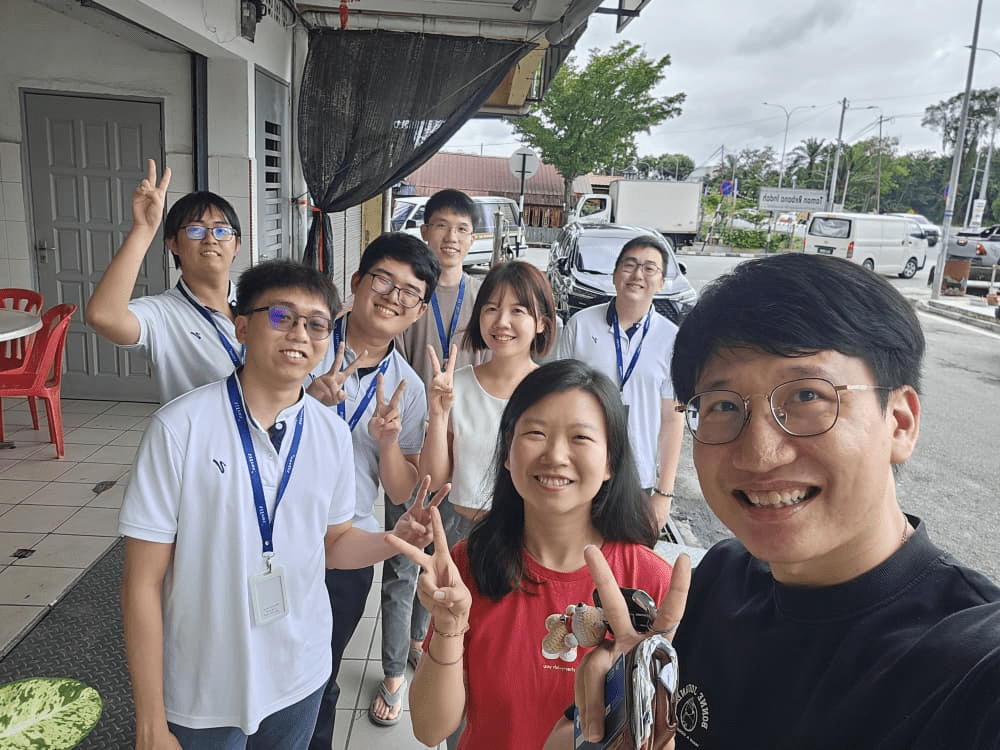
The last photo I had with the SPI team during the farewell lunch
 IT Society MMU Cyberjaya
Leave a comment