
Written by: Kueh Pang Teng and Ow Ka Sheng

Table of Content
- Introduction
- What is your role and your responsibilities?
- Why did you join iFAST Global Hub AI?
- What did you day-to-day look like?
- What were the challenges you faced and how’d you overcome them?
- How did you prepare for the interview?
- What was your greatest achievement in IFAST?
- Were there any fun events or social activities at iFAST?
- Would you guys recommend iFAST to your juniors or batch mates?
Introduction
iFAST Global Hub AI is a technology centre under iFAST Corporation, dedicated to driving innovation in fintech through AI and digital solutions. Based in Kuala Lumpur, it serves as the company’s global digital hub, supporting iFAST’s operations across various markets. This setup opens up exciting opportunities for students in Malaysia to experience the fast-paced world of fintech through internships at iFAST Global Hub AI. In this blog, we’re hearing from Ow Ka Sheng and Kueh Pang Teng, who recently completed their internships at the Hub. They share their experiences, what they learned, and what it was like to be part of a global fintech team pushing the boundaries of technology and innovation.
What is your role and your responsibilities?
Pang Teng: I worked as an ITP Intern, which basically means a full stack developer under the IT Partnership department. I was part of Team ShrewdTech, and in my small team, I mainly worked on enhancements for the stocks and ETFs modules for FSMOne which is iFAST’s online investment platform. I worked on both the frontend and backend including fixing bugs, enhancing the logic and revamping the frontend UI. I actually got to experience the full SDLC cycle from requirement gathering, development, preparing test cases and testing, UAT and all the way into the live environment. Besides that, I also worked on Stella Mind AI, the chatbot agent on iFAST’s iGB website. My main role was refining prompts and improving multiple agents so they could answer users’ enquiries more accurately based on the different use cases. I also got to explore Power BI through building and enhancing dashboards with DAX formulas.
Ka Sheng: I was an ITP intern at iFAST, where ITP stands for the IT Partnership Department. Within the ITP Department, there are multiple teams, each operating like an individual startup. I was part of the ShrewdTech Team, which is further divided into several subgroups. Pang Teng belongs to the ITeam, while I’m in Team A. Interestingly, within Team A, a new subgroup was recently formed to focus specifically on debit card projects, known as the small Team A, which is where Tharshen’s team is based.
In my team, our primary focus was on regular maintenance tasks. As a result, my daily responsibilities mainly involved bug fixing, system enhancements, and minor feature development for the IGB Client Portal and Back Office modules.
Why did you join iFAST Global Hub AI?
Pang Teng: I wanted to gain hands-on experience in a fintech environment, and iFAST stood out to me because it is a Singapore-listed company. I saw it as a great opportunity to build a strong foundation and learn something meaningful from the experience.
Ka Sheng: First of all, the main reason I chose to join iFAST was because of its fast-paced environment. As the company name suggests — iFAST — you have to be ’FAST’ to thrive here. Since my internship only lasted for three months, I wanted to learn as much as possible within a short period of time, and iFAST provided the perfect environment for that.
Secondly, the internship allowance offered by iFAST is one of the highest in the IT industry in Malaysia, reaching up to RM2000, which made it an easy decision for me, it was definitely a “why not?” moment.
What did your day-to-day look like?
Pang Teng: I usually reached the office around 8 am and started off working on my tasks based on their priority. Around 10 am, I would join two daily stand-ups for different projects under my team, which usually lasted around an hour. My team and I would share our progress updates, discuss blockers and plan the day. Then comes my favourite part which is lunch to regain my energy. Sometimes we tapau and eat in the pantry or dine out. After lunch, I would continue working on my tasks, and sometimes I would consult my supervisor or my team to show them my work and address any blockers I faced throughout the day. Then, I would call it a day by updating my supervisor on my progress, usually around 5:45 p.m. or 6:30 p.m.
Ka Sheng: I usually arrive at the office around 8 a.m., which is quite early, so the first scene of mine when i entered the office is always Tharshen laying down on the desk taking his morning nap.
After settling down, I’d open all the communication channels such as Slack, iFAST Chat, and Outlook to check for any updates, new tasks, or requests for assistance. If there were no urgent issues, I would go through my Trello board to continue working on the tasks assigned to me.
Once I completed development work on localhost, a code review session would usually be conducted by my supervisor or another team member. If the review passed, I would then deploy the changes to the UAT environment and perform sanity testing.
At this stage, we would also contact users through iFAST Chat to confirm that the feature or fix met their expectations. Once verified, the user would update the Atlassian ITSM ticket status to indicate that the item was ready for deployment to the next stages, staging and production.
Typically, we had two deployment cycles each month, one in the middle and one at the end of the month. When deployment was approaching, I needed to cherry-pick my commits into a hotfix branch for deployment to the staging environment. I would then conduct sanity testing on both UAT and staging and update the deployment sheet to ensure everything was properly tested and ready to go live.
Since iFAST follows the Agile methodology, we also had a daily stand-up meeting at 3 p.m. every day to share updates about our progress, challenges faced, and plans for the next day.
What were the challenges you faced and how’d you overcome them?
Pang Teng: At the beginning, I was quite overwhelmed since I had never learned about Spring Boot, microservices, or Angular before. I felt very lost navigating such a large codebase as it was my first time. There is always a first time for everything, and I am very glad that my supervisor and team were kind and helpful in guiding me whenever I had questions. Eventually, I started learning through YouTube and ChatGPT, and over time I managed to grasp the basics and understand how things worked. I was also quite nervous whenever I encountered bugs that I could not solve, but my supervisor’s approach was to let me explore on my own first. If I could not fix it within a few hours, I would go to them with my understanding and proposed solution. They would usually provide alternatives or suggestions based on their experience, which really helped shape my problem-solving skills.
Ka Sheng: At the beginning, I was honestly quite lost trying to navigate the huge codebase. Even though I had some foundation in Spring Boot development, I still struggled to locate the relevant code for specific modules. It was overwhelming, and I started experiencing a bit of imposter syndrome. I felt like I didn’t belong there, especially after having “bragged” about my skills on my resume.
On top of that, I still think my first task turned out to be the hardest one of my entire internship.I was new and I had to understand how the MGM (Member-Get-Member) referral system worked in the IGB portal, and then construct the necessary SQL queries on my own even though I didn’t fully know which tables existed or which ones fit my use case.
However, as time went by, I gradually became more familiar with the code structure and learned how to trace relevant logic more efficiently. I also got better at asking questions when I was stuck instead of trying to figure out everything alone. It eventually took me more than a week to complete my first task, but it was a huge learning experience.
Kudos to my supervisor for their patience and guidance throughout that first task.
How did you prepare for the interview?
Pang Teng: I applied for the role through JobStreet but you can also find their openings on the official website. Before the interview, I checked Glassdoor to get an idea of the process, but I think the information was a bit outdated and might vary depending on the team you are applying to. It was initially supposed to be a physical interview, but I requested to have it online since I was still attending classes in Melaka. My preparation mainly focused on understanding my past projects well, being clear about what I wrote in my resume, and brushing up on my programming language skills.
Ka Sheng: It took about two weeks for me to receive a reply from iFAST after submitting my application through their official website. During that waiting period, I prepared myself in both technical and soft-skill aspects for the upcoming interview.
On the technical side, I practiced LeetCode problems and SQL queries, although, in the end, they weren’t really useful during the actual interview. For the interview questions, I did some research on Glassdoor to find the common questions asked by iFAST interviewers and prepared specific answers for them.
And guess what, during the real interview, I actually got the exact same question I had practiced.
What was your greatest achievement in iFAST?
Pang Teng: My greatest achievement was probably how much I learned throughout the internship. I had never worked on such large-scale projects before, and each time I completed a task, I felt a small sense of achievement and improvement compared to when I first started knowing nothing. I was also tasked to complete an assignment within the first two weeks after onboarding and later presented it to my team, which gave me an additional sense of accomplishment. Overall, I gained a lot of knowledge from working on different projects, and being able to juggle multiple tasks while completing them on time made me feel quite proud of myself.
Ka Sheng: My greatest achievement during the internship was definitely the range and depth of tasks I managed to complete. According to my supervisor, I was probably the first intern in the team to be given the opportunity to work on so many backend tasks and even SQL-related work since interns usually aren’t allowed to handle those areas. On top of that, I also completed the highest number of tasks among the interns in the team.
I consider myself lucky to have earned the trust of my supervisor, who gave me the opportunity to explore a wide variety of tasks while maintaining a supportive and pressure-free environment. Through this experience, I learned how to navigate and survive in a large codebase, and more importantly, how to think like a software engineer , especially when it comes to performing impact analysis before diving into actual code development.
Were there any fun events or social activities at iFAST?
Pang Teng: NO i dont think i participated in any social activities maybe fun when our boss belanja our lunch HAHAHAH, i mean i miss frosty friday ice cream every month it taste different when u are working pahit pahit then u have sweet sweet ice cream to make ur day OR group updates was fun HAHAH with the refreshments & everybody is kinda laid back OR maybe fire drill kinda gave us early lunch :). BBUTTTT i do enjoy the massage session it was really nice (maybe dont include this).
Ka Sheng: No, at least in ShrewdTech, there are not many chilling moments because everyone is busy hitting their KPI (Bonus up to 13months). This is a place where everyone is working, learning, solving problems and earning big money haha.
Would you guys recommend iFAST to your juniors or batch mates?
Pang Teng: Yes, if you are looking to improve yourself and gain exposure in the fintech world, iFAST is a great place to learn. They have a variety of projects that allow you to explore both frontend and backend development while understanding how fintech works in real-life applications.
Ka Sheng: It depends, I would only recommend to:
- those who welcome challenges, can handle stress, and don’t rely on constant guidance, and
- those who can speak Chinese, as most communication is in Chinese.
If you meet these conditions, you’re perfectly welcome, you’ll have the chance to learn, grow, and gain the most during your internship.
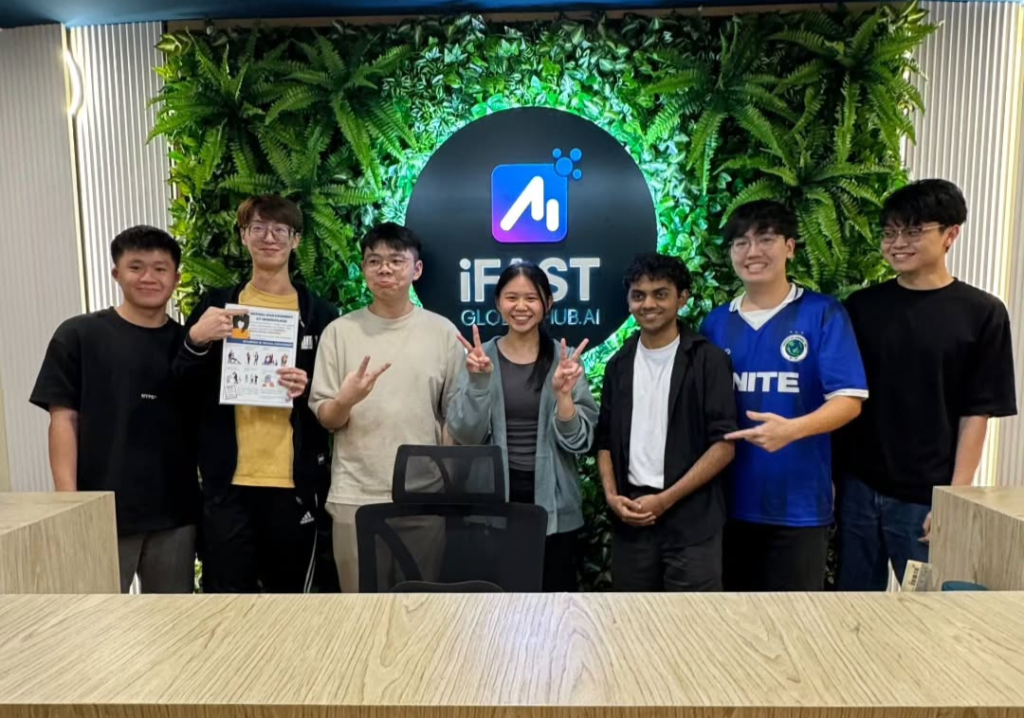
Here’s a photo of us interns from our department together 😀
And that’s a wrap for this blog! Got questions? Don’t hesitate to reach out! You can connect with Ow Ka Sheng and Kueh Pang Teng on LinkedIn.
Until next time! ✌️
 IT Society MMU Cyberjaya
Leave a comment