
Table of Content
- Introduction
- What is your role and your responsibilities?
- Why did you join MoneyLion?
- What did you day-to-day look like?
- What were the challenges you faced and how’d you overcome them?
- How did you prepare for the interview?
- What was your greatest achievement in MoneyLion?
- Were there any fun events or social activities at MoneyLion?
- Would you guys recommend MoneyLion to your juniors or batch mates?
- Anything else you’d like to add?
Introduction
MoneyLion is a financial technology company that provides a range of financial services, including loans, investing, and banking. Their mission is to help people make better financial decisions by offering innovative financial products. While their services are mainly available in the US, their main engineering hub is actually based in Kuala Lumpur. This opens up opportunities for internships at MoneyLion for students in Malaysia. In this blog, we’re hearing from Tharshen A/L Surian Balan and Wong Yen Hong, who recently wrapped up their internships at MoneyLion. They’re here to share their experiences and what it was like to be part of the MoneyLion team. Let’s dive in!
What is your role and your responsibilities?
Tharshen: I was a Web Engineer Intern in the Web Core Team. This team is the main team of the web platform as they’re responsible for the web platform by creating or suggesting new solutions of improvement, constituting best practices to be implemented, and upgrading packages and bug fixes. We also occasionally help build and maintain sub systems in the web app if those don’t fall under the responsibility of the other Web Product teams (also known as pods). Our team is responsible for maintaining three particular systems, the Web App, the Internal Web Design System and the Gateway API. I usually contribute to the Web App the most and a bit to the Design System.
Yen Hong: My role at MoneyLion was as a Data Science Intern in the Machine Learning Solutions team. The team is responsible for developing and maintaining machine learning models. Some of the models they work on include a paycheck detection model, a transaction categorizer, and a feed recommendation engine, to name a few. During my internship, I was given a single project, a fairly long and challenging one, focused on improving the transaction categorizer. The categorizer’s job is to assign users’ transactions into specific categories. For example, if you spent $5 at McDonald’s, it would label that transaction under the Food category. While it worked well for common categories like that, its predictions for rarer ones were pretty much random. My task was specifically to improve its performance for those less common categories.
Why did you join MoneyLion?
Tharshen: Initially, I wasn’t very familiar with MoneyLion. However, my senior, Sidharrth Nagappan, highly recommended it and referred me for the internship. He emphasized that it’s an excellent place to learn and grow as an engineer. After conducting my own research and consulting other seniors, I found that MoneyLion has a strong reputation in creating a great environment for its staff to work in as well as having some of the best engineers to work with. This ultimately made it my top choice.
Yen Hong: I first came across MoneyLion while researching the industry almost a year before my internship, but I didn’t think much of it at the time. A few months later, I found that some of my seniors from Hackerspace MMU had joined MoneyLion, which piqued my interest. I reached out to a few of them to learn more about the company, about what they did, what the culture was like, and all that. The feedback I got was very positive. I found that MoneyLion had a lot of highly skilled people, making it a great place to learn, especially for an intern like me. Around that time, I was also looking for a role related to machine learning because I was interested in how it’s applied in the real world. That gave me yet another reason to apply to MoneyLion, since it was one of the very few companies in Malaysia offering machine learning internships. I knew I had to at least give it a try, and that’s how I ended up there.
What did you day-to-day look like?
Tharshen: I would usually come to the office before 10 am and go through some pull requests that require reviewing. As part of the web core team, we usually review a lot of other pod’s pull requests. On Tuesday’s or Thursday’s, our team will have stand-up meetings to share updates amongst each other and address any blockers (meaning if we have issues with our tasks). Then I would continue my day doing my tasks. My tasks include bug fixes, creating new components, doing research (a LOT OF reading documentation and articles). I would also chat with other teams to learn more about what they do. I got a lot of knowledge just by socialising with these engineers as they tell me things like how they solve their own problems and their past work experiences. Before the day ends, i would update my team lead if there’s anything important and then make my way home (usually around 5 pm to 5:30 pm)
Yen Hong: Besides working on my tasks, I had two team meetings every week. In the first meeting, I’d present the progress of my current tasks to stakeholders. The second meeting was smaller and more interactive, just the team members, where we’d all discuss our projects, share ideas, and try to understand or contribute to each other’s work. On top of that, I had a weekly one-on-one with my manager where we’d chat about pretty much anything, sometimes my tasks, sometimes just random stuff. That was pretty much the regular routine. Every now and then, we’d have learning sessions to explore new topics or technologies that were relevant to our projects. Oh, and during my internship, we also had book club sessions for Designing Machine Learning Systems by Chip Huyen. (also known as the MLE bible)
What were the challenges you faced and how’d you overcome them?
Tharshen: At the start, I was puzzled about many things such as navigating the large Web App repository, communicating with Engineers and trying to solve problems on my own. I won’t lie that it was difficult at the start. I would always ask questions which although can be a good thing, I tend to over do it. Once I was aware of my approach, I learnt to slowly improve it from time to time. I started by thoroughly attempting to solve problems on my own before seeking assistance from my colleagues when necessary. Over the following months, I made significant progress in troubleshooting and problem-solving with minimal guidance. I do ask questions from time to time but it was only for when I don’t understand the requirements or asking for some advice. In short, constantly facing challenges helped me adapt and become more self-sufficient in overcoming obstacles.
Yen Hong: In the first few weeks, I didn’t contribute much because I was still trying to get the hang of my project. I often felt lost, but when that happened, I’d first try to figure things out on my own. If I was still stuck, I’d jot down my questions and then go to either my manager or mentor to discuss them and clear up my doubts. At first, it felt a little intimidating because I was new to everything and didn’t want to bother anyone. But over time, I realized that asking questions is exactly what they want you to do, they genuinely want to help you get up to speed and be productive. Those discussions with my manager and mentor really helped me a lot in completing my project.
How did you prepare for the interview?
Tharshen: Originally, I applied for a backend role, so I did some hackerrank questions to prepare for it. Those questions were all done in Java after I heard that MoneyLion uses SpringBoot (a Backend Java Framework). I did the test but I didn’t pass it unfortunately. After that, I had an online interview with the HR and he placed me for the Web Interview as he noticed I know React and Next.js. For that, I prepared by practising to explain my self made projects, going deep into the technical details while describing the challenges I faced and how I solved them. I practised a bit on some Hackerrank questions by solving them in JavaScript and went through deeper on JavaScript and React concepts like the Event Loop, Thinking in React, how Promises work, etc. I asked my seniors who’re great at Front-end for some advice as well on what I should focus on and what to expect for these kinds of interviews.
Yen Hong: I started my preparation by going to Glassdoor to learn about others’ interview experiences. From there, along with the information gathered from the career page, I created a learning plan for myself to study relevant topics or revise concepts I had learned before, such as SQL and general data science and machine learning concepts. This involved practicing SQL, learning or revisiting various data science concepts, and attempting some Kaggle playground competitions. For the in-person interview, I prepared a list of common questions that were likely to be asked and had mock interviews with a friend to practice.
What was your greatest achievement in MoneyLion?
Tharshen: It has to be not relying on ChatGPT. I barely relied on AI to solve my problems and instead read a lot of the documentation for the tools and their Github Issues to see how other developers / engineers solve similar problems to me.
Yen Hong: Fixing my sleep schedule. Completing the project I was given and presenting it to almost everyone there. It felt amazing to finish it, especially since, during the first few weeks, I thought it would be impossible to complete before my internship ended. On top of that, being able to share my work with such a big audience made it even more rewarding!
Were there any fun events or social activities at MoneyLion?
This is one of the best things about MoneyLion. They really care about work-life balance! They encourage you to only work during working hours. Outside of that, they organize tons of social activities to help everyone unwind and connect. The first (and everyone’s favorite) social activity is ERG, which are basically company-sponsored social sessions, mostly sports groups. We have groups for everything, such as board games, basketball, badminton, rock-climbing, and even go-karting. Speaking of go-karting, that’s our favorite ERG, but it’s only held once a month because it’s pretty expensive. It’s super popular, though, so we usually have to fight for spots. But it’s not too bad, as long as you sign up early, you’re good to go. Every once in a while, we also have movie sessions and team-building activities. Honestly, there are so many social events at MoneyLion that we couldn’t possibly list them all here!
Would you guys recommend MoneyLion to your juniors or batch mates?
If you really want to level up your skills in a specific field, want to know more about the fintech world or wish to work in an enterprise company, MoneyLion is a very solid choice. The company has talented engineers and supportive managers, excellent employee benefits, and a healthy work culture. These factors make it a great choice for those considering an internship or a full-time role here.
Anything else you’d like to add?
Nope, that’s pretty much it! Oh, and here’s a picture we took at the end of Tharshen’s internship ;).
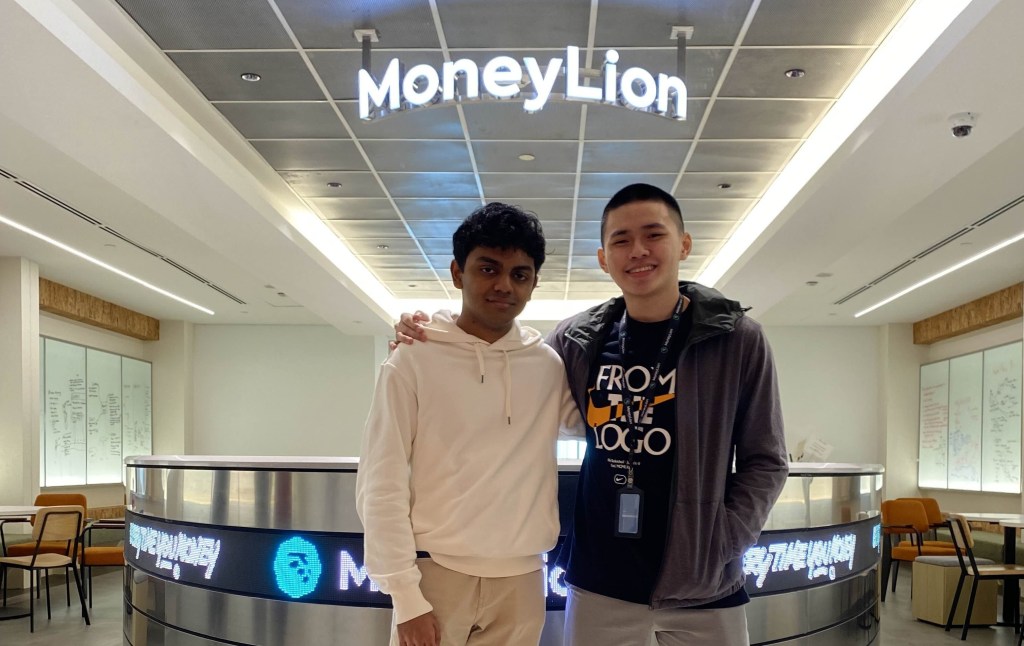
And that’s a wrap for this blog! Got questions? Don’t hesitate to reach out! You can connect with Tharshen and Yen Hong on LinkedIn.
Until next time! ✌️
 IT Society MMU Cyberjaya
Leave a comment